Why Choose a Boomless Sprayer for Global Farming?
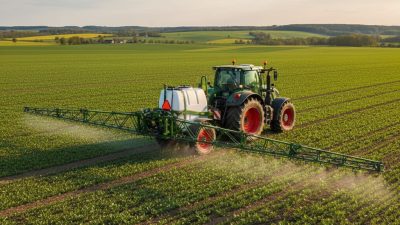
Global farms face rising pressure to spray accurately, conserve water, and cover difficult ground. The FAO AQUASTAT database estimates that agriculture uses about 70% of global freshwater withdrawals. Every unnecessary pass matters. A boomless sprayer can help operators reach uneven fields, pasture edges, orchards, and narrow lanes without carrying a wide metal boom.
Its value becomes clearer when farm conditions change quickly. A conventional boom may strike trees, fences, rocks, or sloping ground. A boomless sprayer uses strategically placed nozzles to create a wider spray pattern from a compact frame. That design can reduce equipment damage and simplify transport between scattered fields. It also suits smaller tractors and utility vehicles, which remain important across emerging agricultural markets.
The evidence requires careful interpretation. FAO’s State of Food and Agriculture 2022 emphasizes that agricultural technology works best when matched to local conditions, skills, and infrastructure. The FAOSTAT Pesticides Use database reports global pesticide use at roughly 3.7 million tonnes in 2022. That figure does not prove that boomless equipment is automatically safer or more efficient. No sprayer fixes poor calibration. Wind, nozzle selection, pressure, speed, and operator training still determine coverage and drift risk.
That caveat matters. Field experience often reveals what brochures miss: a nozzle can clog, a pattern can weaken, or coverage can become uneven near the edges. Yet properly selected equipment can offer practical flexibility. For global farming, the real question is not whether a boomless sprayer replaces every boom system. It is whether its simpler footprint, adaptable reach, and lower collision exposure fit the farm’s actual terrain and workflow.
What Is a Boomless Sprayer and How Does It Work?
Why Choose a Boomless Sprayer for Global Farming?
What Is a Boomless Sprayer and How Does It Work?
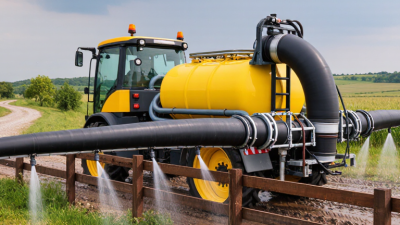
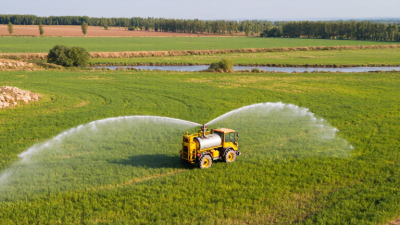
A boomless sprayer applies liquid without long horizontal spray arms. Its nozzle sits near the center of the machine or vehicle. A pump pushes liquid through the nozzle under controlled pressure. The nozzle then forms a wide spray pattern across the field. Air movement and droplet size influence the final coverage.
From practical field checks, boomless units suit uneven ground, narrow paths, orchards, and small fields. They are easier to transport than wide-boom equipment. A farmer can often spray beside fences, rough margins, or growing crops without catching a boom. However, coverage may become uneven when the vehicle moves too quickly. It is not magic.
Pressure, nozzle height, travel speed, and liquid volume all matter. Higher pressure can create smaller droplets, but wind may carry them away. Larger droplets usually resist drift better, though they may reduce coverage. Operators should inspect the pattern using clean water before applying any product. Local instructions, protective equipment, buffer zones, and weather limits still apply.
A boomless sprayer also demands careful calibration. I would not trust a single test across every crop or climate. Dust, humidity, hills, and changing wind can alter results. Record the speed, pressure, and treated width during each trial. That simple record helps reveal missed strips and unnecessary overlap.
How Boomless Sprayers Adapt to Diverse Global Farm Conditions
Why Choose a Boomless Sprayer for Global Farming?
Across global farms, one sprayer rarely suits every field condition. A boomless sprayer uses angled nozzles from a compact frame. This design can follow rough pasture, narrow headlands, and fields divided by trees or stones. It can also reduce boom clearance problems on slopes. That matters where machinery access is limited. FAO AQUASTAT estimates that agriculture accounts for about 70% of global freshwater withdrawals. In dry regions, accurate calibration and steady travel speed may reduce wasted passes. However, boomless equipment does not automatically lower water use.
Humid tropical farms present different challenges. Dense vegetation, wet ground, and uneven surfaces can restrict rigid booms. An adjustable spray pattern may reach around obstacles and across irregular cover. On small, fragmented holdings, lighter equipment can be easier to transport and maintain. An FAO study published in World Development estimates 608 million farms worldwide, with 84% smaller than two hectares. Small plots need careful maneuvering. They also expose overlap quickly.
Local operators must match nozzle output, pressure, and travel speed. Wind changes the result quickly. Spray drift and missed edges remain practical risks. Water-sensitive paper can reveal poor coverage before full application. That is an imperfect but useful check. The USDA Agricultural Research Service highlights droplet behavior and environmental conditions in application management research. Users should test a small area, record coverage, and adjust settings before treating the entire field. Local product labels and buffer requirements still matter.
Why Choose a Boomless Sprayer for Global Farming?
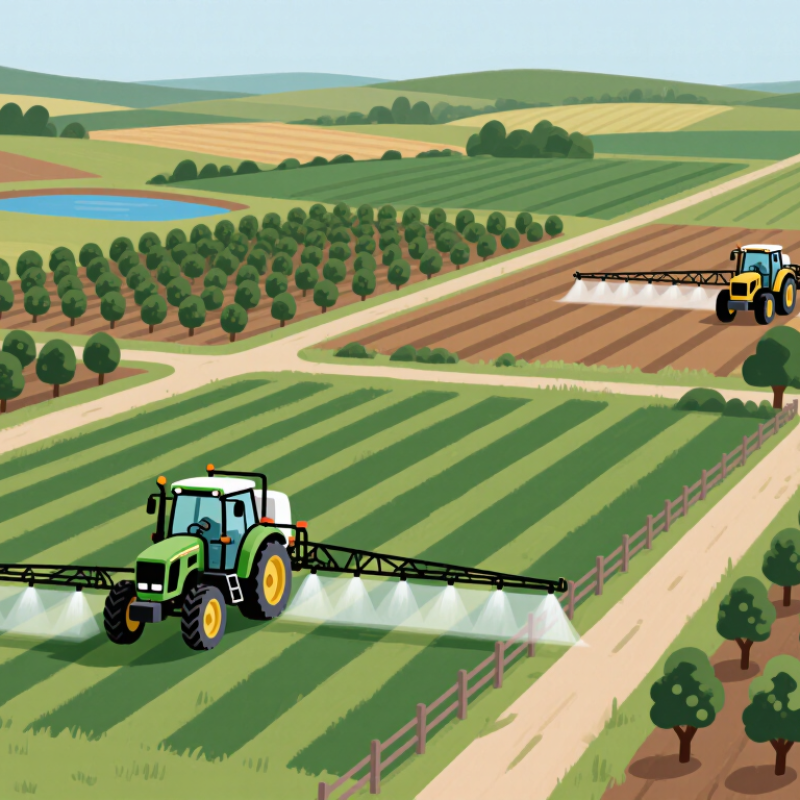
Global agriculture includes both extensive pasture and cropland. A boomless sprayer can be useful where uneven terrain, obstacles, narrow access routes, or irregular field boundaries make a conventional boom difficult to operate.
The chart uses approximate global agricultural land figures for 2022: about 3.2 billion hectares of permanent meadows and pastures and about 1.6 billion hectares of cropland. These diverse environments create demand for flexible application equipment that can work around trees, fences, rocks, slopes, and uneven field edges.
Source: FAO global land-use estimates for 2022. Figures are rounded.
Limitations and Selection Factors for Different Farming Operations
Why Choose a Boomless Sprayer for Global Farming?
Limitations and Selection Factors for Different Farming Operations
A boomless sprayer can suit irregular fields, narrow paths, and small farms with mixed crops. Its wide spray pattern reaches areas where a rigid boom may strike trees, fences, or uneven ground. This flexibility matters in hilly regions and fragmented fields. However, coverage is less predictable near field edges. Wind can carry droplets beyond the target.
Spray height, nozzle design, water volume, and travel speed strongly affect results. A unit that works well on short grass may perform poorly in dense crops. Tall vegetation can block droplets before they reach lower leaves. Operators should check the required application rate with a calibrated container, not rely on visual estimates. Small errors become expensive across large fields. They also need to consider tractor size, tank weight, pump capacity, and available clean water.
Boomless systems are not automatically better for every operation. They may waste spray in open fields, especially during gusty weather. Sensitive crops nearby create another concern. A farmer managing orchards may value maneuverability, while a broad-acre operator may prefer more uniform boom coverage. Local terrain, labor experience, maintenance access, and weather patterns should guide the choice. The judgment is rarely perfect. Even experienced operators sometimes select for convenience and overlook drift control or refill time. A short field test can reveal uneven coverage before a full-season investment.
Best Practices for Safe and Efficient Boomless Sprayer Use
Why Choose a Boomless Sprayer for Global Farming?
Best Practices for Safe and Efficient Boomless Sprayer Use
Boomless sprayers suit uneven fields, orchards, pasture edges, and narrow access routes. Their wide spray pattern works without a rigid boom. However, convenience can hide serious drift risks. Agriculture uses roughly 70% of global freshwater withdrawals, according to FAO AQUASTAT. Efficient application matters, especially where water and chemicals are limited.
Safe operation begins with calibration. Measure the actual spray width, travel speed, and output before entering the field. Recheck them after changing pressure or nozzle settings. Keep the spray low and avoid windy conditions. The U.S. Environmental Protection Agency recommends following product labels, maintaining buffer zones, and reducing drift through weather-aware application. A calm morning may still be unsuitable if temperature inversions trap droplets near the ground. This mistake is easy to miss.
Tips: Wear labeled protective equipment. Inspect hoses and filters daily. Never spray toward people, livestock, waterways, or food crops. Record wind speed, temperature, pressure, and treated area. Stop when gusts become unpredictable. Small errors spread. The FAO’s 2022 State of Food and Agriculture emphasizes improving resource efficiency while reducing environmental pressure. Boomless equipment can support that goal, but only with disciplined control. Operators should review their results after every application. Uneven coverage is not always obvious from the cab. A simple water-sensitive paper test can reveal missed strips and excessive droplets.