
2026 Top Tractor Sprayer Types for Global Buyers
Choosing a tractor sprayer is not just a matter of tank size or purchase price. The right setup depends on crop layout, field area, tractor power, water access, and the operator’s daily routine. A broad-acre farm may favor a boom sprayer, while an orchard with narrow rows may need an air-blast model. Mounted and trailed designs also differ in maneuverability, payload, and how they affect the tractor. Small details matter. A heavy tank can change how a tractor handles on a slope.
This guide compares the main tractor sprayer types global buyers are likely to encounter in 2026. It explains common uses, practical trade-offs, and features worth checking before a purchase. Look closely at boom width, nozzle options, pump capacity, tank material, filtration, and ease of cleaning. Ask whether replacement parts and service support are available in your region. Specifications should be verified against the tractor manufacturer’s limits and the sprayer maker’s operating guidance. That sounds tidy on paper. Field work is less tidy. Row spacing varies, wind shifts, and a poorly calibrated nozzle can waste product or leave uneven coverage. Buyers should consider local crop conditions and follow applicable label instructions. There is no single best machine for every farm. A careful match between equipment and real working conditions is usually more useful than choosing the largest model.
Classify Tractor Sprayers by Mounting System, Spray Method, and Crop
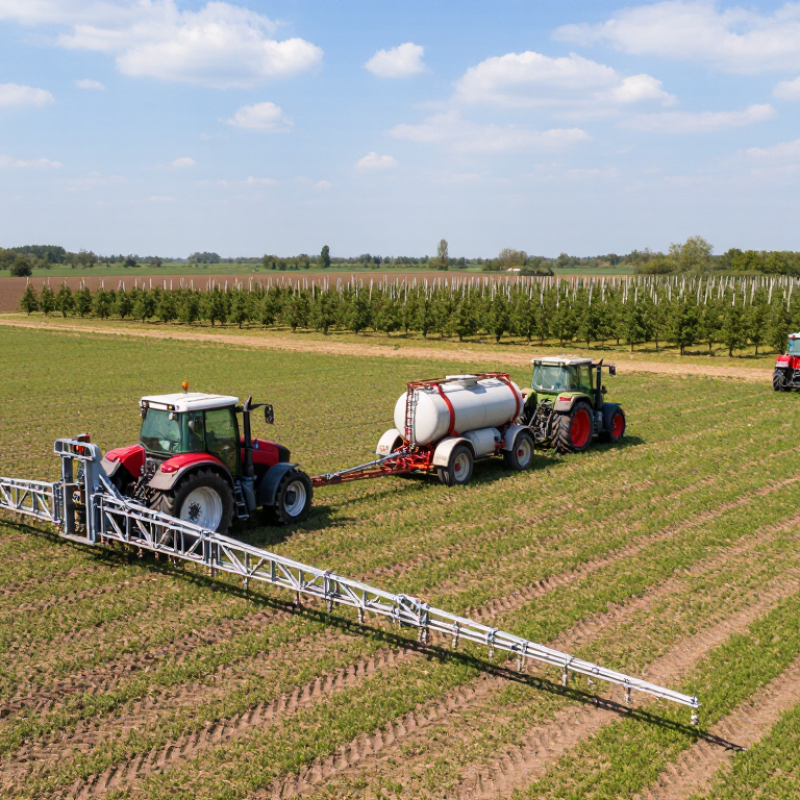
Tractor sprayers are best compared across three dimensions: mounting system, spray method, and crop. Mounted units connect to a tractor’s three-point hitch and suit smaller tanks, narrow headlands, and frequent lifting. Trailed models carry more liquid, but require turning space and a compatible hitch. Tank capacity is not everything. Sloshing on uneven ground can affect handling.
Boom sprayers apply spray across field crops, with nozzle spacing and boom height shaping coverage. Air-assisted sprayers direct droplets into dense orchard or vineyard canopies. Directed or spot spraying can target crop rows, though setup and operator judgment matter. FAOSTAT recorded 3.70 million tonnes of agricultural pesticide use worldwide in 2022. That figure describes use, not sprayer performance or sales, but it highlights why accurate application matters.
Crop conditions guide the final choice. Cereals often need wide, stable booms; orchards need airflow and adjustable outlets around branches. Vegetable rows may call for compact frames and controlled nozzle placement. A practical check is to compare the sprayer’s working width, tank load, and turning radius with the actual field. Categories overlap. A good specification sheet cannot replace a field trial.
2026 Top Tractor Sprayer Types for Global Buyers - Classify Tractor Sprayers by Mounting System, Spray Method, and Crop
| Mounting System | Spray Method | Typical Crops | Best Suited For | Key Selection Considerations |
|---|---|---|---|---|
| Three-point mounted | Hydraulic boom spraying with flat-fan or other application-specific nozzles | Cereals, oilseeds, pulses, and other arable crops | Small to medium fields and farms that need a compact sprayer for broadcast applications | Match tank load and boom width to tractor lift capacity and stability. Check nozzle choice, operating pressure, boom height, and drift conditions. |
| Trailed, drawbar-mounted | Hydraulic boom spraying | Wheat, maize, soybean, cotton, and other broadacre crops | Farms needing greater liquid capacity or a wider boom than a mounted unit can typically provide | Check tractor drawbar and hydraulic requirements, turning space, transport width, ground clearance, and the availability of suitable field access. |
| Semi-mounted | Hydraulic boom spraying | Large-scale arable crops, including cereals and oilseeds | Operations seeking a larger-capacity boom sprayer with part of the machine weight carried by the tractor | Confirm compatibility with the tractor hitch and hydraulic system. Consider headland maneuverability, axle load, and field soil conditions. |
| Three-point mounted | Air-assisted, radial-fan spraying with directed nozzles | Small orchards, tree fruit, and some vineyards | Compact plantings where air helps carry droplets into and through a crop canopy | Choose fan output and nozzle arrangement to suit canopy size and density. Adjust airflow and application rate to limit off-target drift. |
| Trailed, drawbar-mounted | Air-assisted orchard spraying, commonly using a radial fan and directed nozzles | Orchards, including fruit and nut crops | Established or larger orchard blocks where more tank capacity and longer operating time are useful | Check row spacing, turning radius, fan airflow, nozzle orientation, and whether the spray reaches the target canopy without excessive overspray. |
| Three-point mounted or trailed | Air-assisted vertical-boom spraying | Vineyards and other crops grown in regularly spaced rows | Directed treatment along vertical crop faces, where spray outlets can be positioned beside the canopy | Confirm that the boom height and outlet spacing match the crop row. Airflow and travel speed should be adjusted for canopy size and wind conditions. |
| Three-point mounted | Hydraulic band or directed spraying, often with shields | Row crops such as maize, vegetables, and some plantation crops | Applying spray to a crop row, inter-row area, or defined target zone instead of the entire field surface | Set outlet spacing and boom height to row geometry. Use appropriate shields and follow crop-stage and product-label directions to reduce crop contact. |
| Three-point mounted or trailed | Hydraulic hose-and-wand or spray-gun application | Small orchards, nurseries, and mixed-use farms | Spot treatment or applications to accessible individual plants and localized areas | Useful reach depends on pressure, hose length, and operator technique. Avoid treating this method as a substitute for calibrated canopy coverage or drift control. |
Selection note: Sprayer performance depends on tractor compatibility, crop structure, nozzle and airflow setup, calibration, weather, and the pesticide label. Always follow local regulations and product instructions.
Related Posts
-
How to Choose the Best Boom Sprayer for Your Agricultural Needs
-

What Is the Best Tractor Sprayer Made in China?
-
What Is the Best 3 Point Hitch Sprayer for Tractors?
-
2026 Best 3 Point Hitch Sprayer for Your Farming Needs?
-
What Is the Best 3 Point Sprayer from China?
-
7 Best 3 Point Sprayers for Tractors in 2026