Top 10 Types of Distillery Filtration Equipment?
Choosing the right distillery filtration equipment affects clarity, flavor stability, yield, and production confidence. This guide examines ten practical filtration types used across modern beverage operations. It considers cartridge filters, plate filters, lenticular systems, membrane units, bag filters, depth filters, activated carbon systems, crossflow filters, filter presses, and polishing filters.
Dr. Charles W. Bamforth, a respected beverage scientist, has offered a useful principle: “Filtration is a process tool, not a cure for poor production control.” That warning deserves attention. Clear spirit begins with clean ingredients, controlled fermentation, careful distillation, and hygienic storage. Equipment cannot correct every upstream mistake. Sometimes, the most expensive filter only hides a process problem for a short time.
Good distillery filtration also requires practical judgment. Operators must compare micron ratings, flow capacity, pressure limits, cleaning requirements, and product sensitivity. A filter that protects vodka clarity may remove desirable character from a botanical spirit. A system that works beautifully at pilot scale may struggle beside a busy filling line. Small details matter. Watch the pressure gauge. Inspect the housing seals. Record each changeout. Taste the product afterward.
This overview keeps compliance and food safety in view. It focuses on sanitary, legally permitted equipment and documented operating practices. The rankings are not absolute. Every distillery has different water quality, spirit composition, throughput, and budget constraints. That is the uncomfortable part. The “best” filtration system may still be the wrong choice without testing, validation, and operator experience.
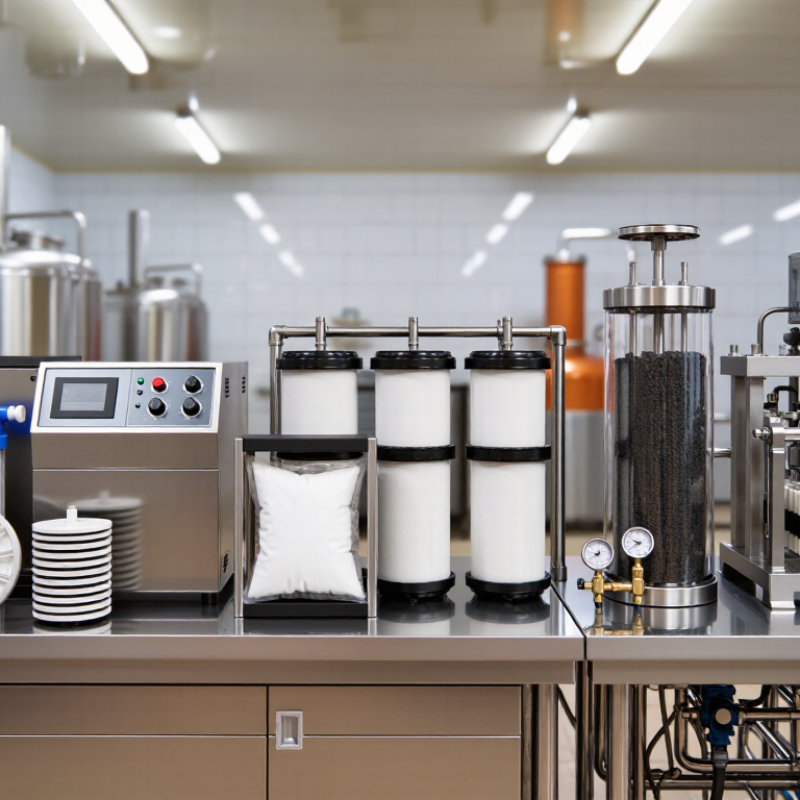
Screen and Basket Filtration for Removing Coarse Solids
Top 10 Types of Distillery Filtration Equipment: Screen and Basket Filtration for Removing Coarse Solids
Screen and basket filters are practical tools for removing coarse solids before pumping, heating, or further processing. They can capture grain fragments, fruit pulp, botanical pieces, and loose carbon particles. A screen filter usually supports continuous flow, while a basket filter allows operators to lift out collected material quickly. In a busy distillery, that difference matters. Less downtime helps protect production schedules.
Filter selection should match the liquid, temperature, flow rate, and expected solids load. A fine opening may improve clarity, but it can clog rapidly when the liquid contains fibrous material. That choice can backfire. Operators should monitor pressure changes, inspect the screen surface, and record cleaning intervals. Sanitary welds, smooth internal surfaces, and suitable stainless steel construction also support reliable cleaning. However, a filter that performs well during a small trial may struggle during peak production. Testing under realistic conditions is essential.
Tips: Keep a spare basket ready during high-solids runs. Clean screens before deposits harden. Check the gasket after every removal. Do not judge performance by appearance alone; measure flow and pressure. If clogging happens repeatedly, review the opening size, basket depth, and upstream mixing process. A slightly larger opening may improve stability, although it could allow more solids through. That trade-off deserves careful review.
Bag and Cartridge Filters for Depth-Based Clarification
In a distillery, clear spirit often begins with controlled depth filtration rather than a finer membrane. Bag and cartridge filters trap suspended particles within a porous structure, not merely on the surface. This design helps capture char fines, grain dust, and processing debris before filling. The result is a cleaner appearance with less rapid surface blinding. Good filtration is visible in the vessel.
Bag filters suit higher flow rates and larger solids loads. A properly sized bag can protect downstream cartridges and reduce replacement frequency. Cartridge filters offer more consistent retention when the liquid needs tighter clarification. Depth ratings should match the expected particle burden, viscosity, temperature, and flow rate. In practice, operators should monitor differential pressure at the inlet and outlet. A sudden rise may indicate loading, poor prefiltration, or an incorrectly selected grade. Do not judge performance by clarity alone. Some particles remain too small to see.
Sanitary housings, compatible seals, and documented changeout procedures support reliable operation. Filter contact materials should be verified for the process liquid and operating temperature. Record batch conditions, pressure readings, and service intervals for repeatable decisions. I have found that rushed changes create more inconsistency than modestly conservative flow rates. That lesson is easy to overlook. A staged bag-to-cartridge setup may improve protection, yet it still requires validation under actual production conditions.
Plate-and-Frame and Lenticular Filters for Beverage Polishing
Top 10 Types of Distillery Filtration Equipment?
Plate-and-frame and lenticular filters remain practical choices for beverage polishing. Plate-and-frame systems use stacked plates, sheets, and controlled pressure. They suit spirits requiring visible clarity and adjustable filtration depth. Lenticular filters use enclosed modules with less exposure to air. This design helps protect delicate aromas during final polishing. According to the 2024 DISCUS Economic Briefing, spirits represented 42.2% of the United States beverage alcohol market by revenue in 2023. That scale increases pressure for consistent appearance, but clarity alone cannot define quality.
Filtration performance depends on turbidity, temperature, viscosity, and filter-media selection. A cold spirit may form haze after filtration. A warmer sample may appear clear, then change overnight. The Global Beverage Processing Equipment market was valued at approximately USD 58 billion in 2023, according to Grand View Research’s 2024 market analysis. Such investment supports better equipment, yet operators still need disciplined testing. Perfect filtration does not exist. Aroma loss remains a real trade-off.
Tips: Start with a small trial batch. Measure flow rate, pressure, turbidity, and sensory changes. Lenticular units can simplify closed handling, while plate-and-frame filters offer easier visual inspection. Keep the final product temperature consistent during testing. Do not trust appearance alone. A clear sample can still feel thin, muted, or unbalanced. Record each filter change, because small adjustments often reveal more than expensive equipment.
Diatomaceous Earth and Activated Carbon Filtration Systems
Top 10 Types of Distillery Filtration Equipment
Diatomaceous Earth and activated carbon filtration Systems
Filtration controls clarity, texture, and flavor in many distilled beverage processes. Among the ten major equipment types, diatomaceous earth and activated carbon systems require careful operation. Diatomaceous earth, or DE, forms a porous cake inside a filter chamber. This cake captures fine particles while liquid passes through. Flow must remain steady. Operators monitor pressure rise, turbidity, and filter loading during each run. A sudden pressure increase often signals poor DE distribution or excessive solids. DE selection affects retention, throughput, and waste volume. Fine grades polish more effectively, but they can slow production. That trade-off deserves testing.
Activated carbon systems address color, trace odors, and selected flavor compounds. Carbon can reduce unwanted notes, but it may also remove desirable aromas. Contact time, bed depth, temperature, and flow rate influence performance. Too much carbon may create a clean but characterless result. Pilot trials matter. In practice, filtration works best when operators compare laboratory samples with production batches. A cartridge filter may protect downstream equipment from carbon fines. Sanitary housings, sealed connections, and documented cleaning procedures support reliable operation. Records should include pressure readings, media quantities, batch temperature, and sensory observations.
Small sampling errors can distort process decisions. The process is not perfectly predictable. Even experienced teams sometimes over-polish a batch. That mistake can reveal the need for shorter contact times or gentler DE grades. Cleaning and disposal procedures must follow local requirements and facility safety controls. No system replaces sensory checks, laboratory testing, and documented release criteria.
Top 10 Types of Distillery Filtration Equipment? - Diatomaceous Earth and Activated Carbon Filtration Systems
| No. | Equipment Type | Primary Filter Media | Typical Filtration Range | Main Distillery Application | Typical Operating Pressure | Key Advantages | Common Limitations |
|---|---|---|---|---|---|---|---|
| 1 | Plate-and-Frame Diatomaceous Earth Filter | Diatomaceous earth deposited on filter sheets or support plates | Approximately 1–10 µm, depending on grade and cake thickness | Clarifying spirits, fermented wash, liqueurs, and low-viscosity process liquids | Generally 1–3 bar differential pressure | Flexible media selection; effective removal of suspended solids and haze-forming particles | Manual media handling; spent DE requires controlled disposal; can generate dust |
| 2 | Pressure Leaf Diatomaceous Earth Filter | Diatomaceous earth precoat and body-feed slurry on vertical or horizontal leaves | Approximately 1–10 µm for clarification service | Continuous or batch clarification of spirits, wash, and botanical extracts | Generally 1–5 bar differential pressure | Large filtration area in a closed vessel; lower exposure to air than open plate systems | Requires cake formation and cleaning; pressure drop rises as the DE cake loads |
| 3 | Pressure Candle Diatomaceous Earth Filter | Diatomaceous earth cake supported on porous candles | Approximately 0.5–10 µm, selected by DE grade and process design | High-clarity filtration before storage, blending, or final polishing | Generally 1–5 bar differential pressure | Compact footprint; enclosed operation; suitable for relatively high throughput | Requires careful precoat control and periodic cake discharge or cleaning |
| 4 | Lenticular Depth Filter | Cellulose, polypropylene, or cellulose-DE depth-filter modules | Common nominal ratings from about 0.5–10 µm | Polishing of spirits, liqueurs, and colored or particulate-sensitive products | Usually 0.5–2 bar differential pressure | Enclosed and hygienic; good depth-loading capacity; easy module replacement | Single-use modules create solid waste; not intended for heavy solids loading |
| 5 | Activated Carbon Fixed-Bed Filter | Granular activated carbon, commonly produced from coconut shell, wood, or mineral sources | Adsorption process rather than a fixed particle-size rating; removes selected organic compounds | Reduction of unwanted color, odor, and flavor compounds in selected spirit-processing applications | Typically about 0.5–3 bar pressure loss, depending on bed depth and flow | High internal surface area; can reduce trace organic compounds through adsorption | May remove desirable flavor compounds; requires validated contact time and carbon replacement or regeneration |
| 6 | Activated Carbon Cartridge Filter | Carbon block or granular activated carbon cartridge | Adsorption-based treatment with optional particulate prefiltration | Small-batch polishing, odor reduction, and point-of-use treatment | Commonly about 0.2–2 bar differential pressure | Simple installation; compact; easy to change between product campaigns | Limited adsorption capacity; can clog quickly without an upstream solids filter |
| 7 | Bag Filter Housing | Polypropylene, polyester, or other porous filter bags | Typical nominal ratings from about 1–100 µm | Removal of coarse solids, carbon fines, DE particles, and processing debris | Usually 0.1–1.5 bar differential pressure | High dirt-holding capacity; economical prefilter; straightforward operation | Lower final clarity than fine cartridges or membranes; bag replacement is required |
| 8 | Depth Cartridge Filter | Graded-density polypropylene, cellulose, or blended depth media | Common nominal or absolute ratings from about 0.5–10 µm | Intermediate clarification before final membrane or sterile filtration | Generally 0.2–2 bar differential pressure | Captures particles throughout the media depth; available in many pore ratings | Disposable waste; performance depends strongly on solids loading and product viscosity |
| 9 | Membrane Microfiltration System | Polymeric or ceramic membranes with approximately 0.1–1.0 µm pores | Microbial cells and suspended particles larger than the membrane pore size | Final clarification, bioburden reduction, and polishing of low-solids liquid streams | Typically about 0.5–3 bar transmembrane pressure | Consistent separation; ceramic options tolerate frequent cleaning and higher temperatures | Membrane fouling; requires pretreatment, cleaning procedures, and flow control |
| 10 | Ultrafiltration or Cross-Flow Membrane System | Tight polymeric or ceramic membranes, commonly rated by molecular-weight cut-off | Retention of colloids, macromolecules, haze precursors, and some microorganisms | Specialty clarification, concentration, wastewater recovery, and treatment of complex process streams | Often about 2–10 bar transmembrane pressure | Continuous operation; reduced filter-media consumption; useful for difficult-to-clarify liquids | Higher capital and operating complexity; can alter product composition and requires robust cleaning control |
Note: Pressure, pore-size, and performance values are typical engineering ranges. Actual results depend on alcohol content, temperature, viscosity, solids loading, filter-media grade, flow rate, and required product clarity.
Crossflow Membrane and Ultrafiltration Equipment
Top 10 Types of Distillery Filtration Equipment?
Crossflow Membrane and Ultrafiltration Equipment
Crossflow membrane systems keep liquid moving parallel to the membrane surface. This motion reduces cake formation during spirit, wash, or botanical extract clarification. Ultrafiltration uses tighter pores to retain proteins, colloids, and larger color bodies. It can improve brightness while preserving selected dissolved aromas. The two methods are related, but they are not interchangeable. Crossflow is often a process configuration; ultrafiltration describes a separation range.
In practical trials, feed temperature, viscosity, and suspended solids change performance quickly. A clear liquid at the inlet may become cloudy after a long run. Track transmembrane pressure, flux, conductivity, and permeate clarity at short intervals. Sanitary fittings and validated cleaning cycles are essential. Membrane material must tolerate the process liquid and approved cleaning chemicals. I have found that operators sometimes chase higher flow, then lose stability. More flow is not always better. Pilot testing remains important because real feed streams vary by batch. That uncertainty deserves attention.
Tips: Start with coarse screening when solids are visible. Protect the membrane from sudden pressure spikes. Keep a simple log of temperature, pressure, flow, and cleaning results. Check aroma retention, not only visual clarity. A small sample can reveal fouling early. Review the data honestly; an imperfect trial may expose the best design change.