10 Tips for Buying an Antique Dressing Table
An Antique Dressing Table can bring warmth and practical storage to a bedroom, but its appearance tells only part of its story. Before buying, examine its structure, surface, mirror, and signs of repair. A drawer that catches, a loose joint, or newly applied varnish may affect both use and future care. Look closely. Measure the room, including the space needed to open drawers and sit comfortably.
Designer and craftsman William Morris offered a useful principle: “Have nothing in your houses that you do not know to be useful or believe to be beautiful.” His words are not about dressing tables specifically, but they help frame a thoughtful purchase. Choose a piece that suits your needs as well as your taste. Check whether the mirror is original, and ask the seller what is known about the table’s age and history. Details matter.
This guide’s ten tips cover condition, materials, authenticity, proportions, pricing, and safe delivery. Compare similar pieces, but treat online descriptions as starting points, not proof. Photographs can hide worn veneer or uneven repairs. Even careful buyers can miss something. I would not pretend that every old mark has a clear explanation; sometimes the evidence is incomplete. A patient inspection, clear questions, and a realistic budget can help you buy with fewer surprises—and enjoy the table for what it is, not merely what its label claims.
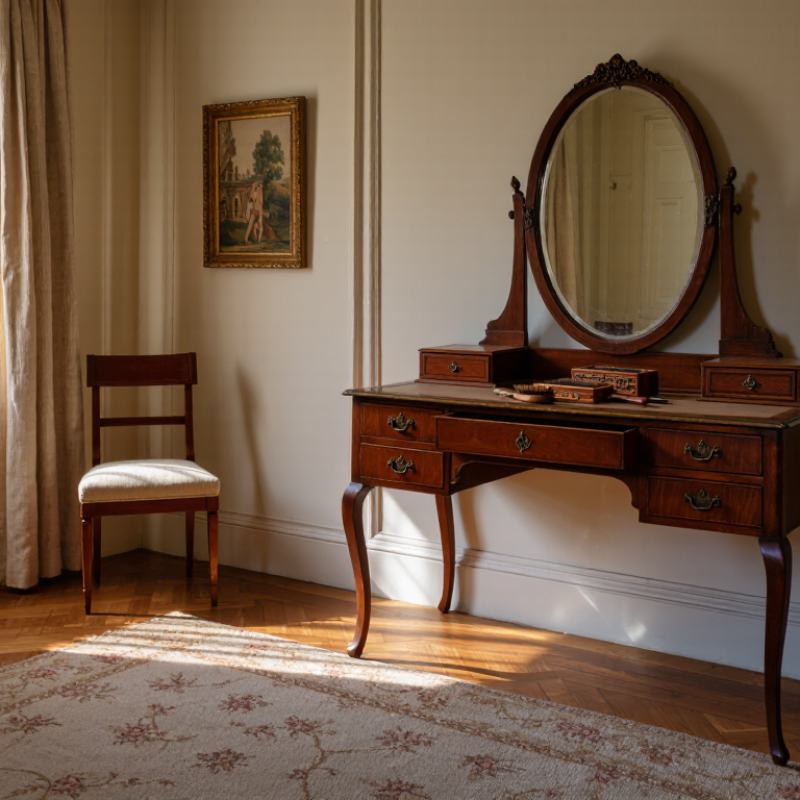
Define Your Needs, Budget, and Preferred Antique Styles
Before browsing, decide what the dressing table must do. Will it hold daily cosmetics, jewelry, or mostly serve as a bedroom focal point? Measure the wall, doorway, and available floor space; a wide table can look graceful online but crowd a narrow room. Measure twice. Note whether you need drawers, a usable mirror, or space for a stool. Leave room.
Set a spending limit that includes more than the purchase price. Delivery, minor repairs, and replacing missing hardware can add up. Inspect drawer joints, veneer edges, and the mirror’s reflective surface in natural light. Cloudiness, small losses, or uneven wear may be acceptable, but repairs can be costly. Ask the seller what is original and what has been restored. If details are unclear, treat the price cautiously rather than assuming every flaw is charming.
Choose styles by features you genuinely like, not by a label alone. A bowed front, carved legs, or restrained geometric lines can help you compare different periods and influences. Save a few reference images, then notice which shapes keep drawing your eye. It is easy to fall for ornate carving and later find it difficult to clean. That is worth admitting. A simpler table may suit daily use better, even if it feels less romantic at first. Antique descriptions can be inconsistent, so compare construction and proportions instead of relying on a style name by itself.
10 Tips for Buying an Antique Dressing Table — Define Your Needs, Budget, and Preferred Antique Styles
Compare the approximate lengths of three British historical periods when narrowing down the style of dressing table you prefer. The dates follow the reigns commonly used as period markers; furniture styles and their transitions may span these boundaries.
Verify the Dressing Table’s Age, Materials, and Authenticity
Before buying an antique dressing table, look beyond its overall style. Compare its proportions, drawer layout, and decorative details with examples from the period it is said to represent. Style can be copied. Check the underside, drawer backs, and interior corners, where construction clues are often easier to see. Hand-cut dovetails may suggest age, but they are not proof on their own.
Inspect the materials in natural light. Solid wood, old veneer, and later repairs can appear together on one piece. Look for consistent wear around handles and drawer edges, plus a finish that has aged naturally rather than evenly across every surface. Check the mirror for signs of replacement, cloudy areas, or waviness. Small irregularities matter. A perfectly uniform surface may be newer, though careful restoration can also create that appearance.
Ask the seller for a clear account of the table’s history, known repairs, and any available records. Compare those details with what you can observe, and request close photographs of joints, hardware, and damaged areas. If the price depends on a specific date or maker, consider an independent furniture appraiser. I would not treat one old-looking screw as a verdict; even experienced buyers can misread a repaired piece. Authentication is rarely tidy.
Inspect Its Structure, Surface, Drawers, and Original Features
An antique dressing table should feel stable before its age or finish catches your eye. Place it on a level floor and gently test each corner for rocking. Check the legs, stretchers, and joints for movement, fresh glue, or mismatched wood. Look underneath for cracks and repairs that may not show from standing height. A little wear is expected. Serious looseness needs closer attention.
Examine the surface in natural light. Fine scratches, faded patches, and small areas of finish loss can be consistent with long use. A glossy, uniform coating may be later, though appearance alone cannot confirm its age. I find this easy to misjudge, especially under warm shop lighting. Not every mark is damage. Open every drawer and slide it slowly. Look for sticking, broken runners, uneven gaps, and musty smells. Check the drawer bottoms and backs for splits or signs of replacement. A drawer that closes smoothly is useful, but it does not prove the whole piece is sound.
Compare handles, escutcheons, mirror fittings, and trim across the table. Consistent wear can support the impression that features belong together; mismatched screw holes may suggest changes. Look for old fixing marks before assuming a missing piece was original. Small clues matter. If a mirror tilts, test its support gently rather than forcing it. Record repairs and uncertainties before buying, since even careful inspection cannot reveal every hidden weakness.
Compare Prices, Provenance, and Seller Reputation
When comparing antique dressing tables, look beyond the asking price. A low price may reflect loose joints, missing handles, or a replaced mirror rather than a hidden bargain. Compare pieces with similar age, materials, size, and condition. Include delivery and likely repairs in your estimate. A small drawer that sticks can be easy to fix; a cracked veneer across the front may take skilled work. Ask for close photographs of the feet, joints, drawer interiors, and mirror backing. Look closely.
Provenance can add useful context, but it should be supported by details. Ask what is known about the table’s age, previous ownership, and restoration history. Old receipts, inventory notes, or family records may help, though none proves every claim on its own. I would not treat a confident story as evidence. Compare it with visible construction, hardware, and wear, and be comfortable with uncertainty when records are incomplete.
Seller reputation matters as much as the object. Read detailed reviews, especially comments about accurate descriptions, safe packing, and how problems were handled. Ask whether the seller accepts returns and get restoration disclosures in writing. A knowledgeable seller should answer specific questions without rushing you. Ask twice if needed. If answers stay vague, pause before paying. Even careful buyers miss details, so a second opinion from a qualified furniture appraiser can be worthwhile for a costly purchase.
10 Tips for Buying an Antique Dressing Table — Compare Prices, Provenance, and Seller Reputation
Use this checklist to compare pieces on a like-for-like basis. Prices vary by age, region, condition, materials, and quality; treat asking prices as comparisons, not proof of value.
| No. | Buying tip | What to check | How to compare or verify |
|---|---|---|---|
| 1 | Compare genuinely similar prices | Look for examples with similar dimensions, materials, style, condition, and completeness. | Compare several current listings and, where available, completed-sale records. Separate asking prices from confirmed sale prices, and note the date and location of each comparison. |
| 2 | Calculate the full cost | Include the purchase price, delivery, insurance, applicable taxes, and any required repairs or restoration. | Compare the total delivered cost rather than the ticket price alone. Ask for a written delivery estimate and clarify who is responsible for packing and transit damage. |
| 3 | Ask for provenance | Request records that support the piece’s ownership history, such as dated receipts, estate records, old photographs, or collection documentation. | Check that documents refer to this specific table and that dates and descriptions are consistent. A detailed history can be useful, but an unsupported story is not proof of age or origin. |
| 4 | Question the age and attribution | Ask what evidence supports the stated period, maker, or place of origin. “Antique” definitions can differ by jurisdiction. | Look for a clear explanation based on construction, materials, documented history, or specialist assessment. Treat labels such as “period” or “in the style of” carefully; they do not always mean the piece was made during that period. |
| 5 | Inspect construction and stability | Check joints, legs, drawer runners, handles, feet, and the frame supporting the mirror. Look for movement, splits, or repairs. | Ask for close-up photographs of joints and the underside, or inspect the table in person. Request disclosure of structural repairs and avoid forcing stiff drawers or fragile fittings. |
| 6 | Assess condition and restoration | Examine the finish, veneer, surface, and interior for losses, lifting, stains, replaced parts, or signs of restoration. | Ask which parts are original and what work has been done. Compare condition-adjusted prices, and get a qualified restorer’s estimate if repairs could affect your budget or intended use. |
| 7 | Check the mirror carefully | Look for cracks, loose fittings, damage to the frame, and age-related changes in the reflective surface. | Request clear photographs taken straight on and at an angle. Ask whether the mirror is original or a replacement, and whether it is securely fitted for transport and display. |
| 8 | Measure the piece and your space | Confirm overall height, width, depth, knee clearance, mirror height, and the dimensions of doorways or stairways on the delivery route. | Ask for measurements in consistent units and verify them yourself. Check whether the mirror or other parts can be safely detached before delivery; do not assume they can be removed. |
| 9 | Check seller reputation and terms | Review independent feedback, accurate descriptions, response to questions, payment terms, return policy, and damage procedures. | Look for a consistent record of resolving issues, not just positive ratings. Get the condition, measurements, provenance claims, and agreed terms in writing before paying. |
| 10 | Protect the purchase and plan care | Confirm that the table can be packed and transported appropriately, and ask about any special care needs of its materials and finish. | Keep the invoice, photographs, measurements, and condition notes. Use stable indoor conditions, avoid direct heat or prolonged strong sunlight, and seek conservation advice before attempting repairs or cleaning. |
Plan the Purchase, Delivery, and Long-Term Care
Before buying, ask for clear photographs of the dressing table’s joints, drawer interiors, and underside. These details can reveal repairs or wear that a polished front hides. Open each drawer and check that it moves without forcing. Measure the table, then measure doorways, stair turns, and hallway corners. Measure the route too. I learned this late. Leave room in your budget for delivery and minor repairs, not just the purchase price.
Confirm who will carry the table and whether delivery includes stairs. Antique furniture can be awkward and heavier than it looks, especially with a mirror attached. Ask if the mirror and drawers should be removed for transport. Get the delivery terms in writing, including what happens if the piece arrives damaged. Photograph its condition before and after the move. Small marks can be difficult to distinguish later.
Once it is in place, keep the table away from direct sunlight, radiators, and damp walls. Stable indoor humidity helps reduce wood movement, though older pieces may still shift with the seasons. Dust with a soft, dry cloth; avoid harsh cleaners and frequent polishing, which can affect the finish. If a joint feels loose, have an experienced furniture restorer assess it before using the table heavily. Do not rush restoration. A worn surface may be part of its history, and not every flaw needs fixing.