
Why Is Inulin Powder Used in Food Products?
Inulin Powder appears in foods for practical reasons, not just nutrition claims. Made mainly from chicory roots, it can add soluble fiber, contribute mild sweetness, and help create a fuller texture. In a yogurt cup, that may mean a smoother spoonful; in a reduced-sugar bar, it can help replace some bulk lost when sugar is lowered. Its performance depends on the food matrix, processing conditions, and amount used.
Market interest is growing. Grand View Research estimated the global inulin market at about USD 1.9 billion in 2022 and projected a 6.8% compound annual growth rate from 2023 to 2030. These are market estimates, not proof that every product benefits from adding inulin. Marcel Roberfroid, a leading prebiotic researcher, described a prebiotic as “a selectively fermented ingredient that allows specific changes, both in the composition and/or activity in the gastrointestinal microflora that confers benefits upon host well-being and health.” That definition helps explain why inulin attracts food developers, while also reminding readers that ingredient function and health effects are not identical.
The trade-off is real. Larger amounts can cause gas or digestive discomfort for some people, and a powder that works well in one recipe may feel gritty or overly dense in another. Not magic. Understanding why manufacturers use Inulin Powder means looking at fiber content, texture, sweetness, cost, and consumer tolerance together. The details matter.
What Is Inulin Powder and How Is It Made?
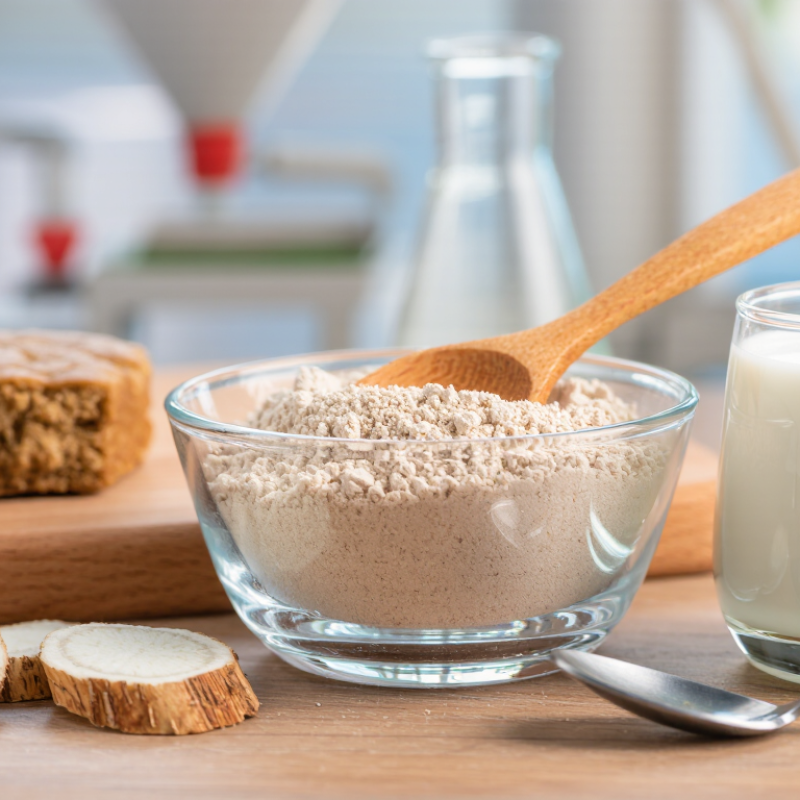
Inulin powder is a soluble dietary fiber found naturally in plants such as chicory roots, onions, and garlic. Commercial food-grade inulin is commonly made from chicory. It appears as a fine, pale powder and has a mild taste, so it can blend into many recipes without adding much flavor. It is not fully digested in the small intestine; gut microbes ferment it in the colon. That matters.
To make it, producers clean and slice harvested chicory roots, then use warm water to draw out the inulin. The liquid is filtered to remove plant material and concentrated. Further purification may reduce sugars and other soluble components. The resulting syrup is dried, often into a powder that can be stored and measured for food production. Exact steps vary by facility and product specification.
The process sounds tidy on paper; roots are less uniform. Growing conditions and processing choices can affect the inulin’s chain length and the powder’s behavior in a recipe. Shorter-chain fractions may dissolve differently from longer ones. In a test kitchen, a small spoonful can disappear into yogurt, while a larger amount may change its thickness or texture. It is worth checking how a particular powder performs rather than assuming every batch acts alike.
Why Is Inulin Powder Used in Food Products? - What Is Inulin Powder and How Is It Made?
| Dimension | Details |
|---|---|
| What inulin powder is | A powdered form of inulin, a naturally occurring soluble dietary fiber made of fructose units. It belongs to a group of carbohydrates called fructans. |
| Common plant sources | Commercial inulin is commonly extracted from chicory root. Inulin also occurs naturally in plants such as Jerusalem artichoke, onion, garlic, and asparagus. |
| How it is made | For chicory-derived inulin, roots are typically cleaned and cut, then extracted with warm water. The extract is filtered and purified, concentrated, and dried—often by spray drying—to produce a powder. |
| Dietary-fiber enrichment | Food makers add inulin to increase the fiber content of products such as cereals, snack bars, dairy foods, and baked goods. The amount of fiber in a finished product depends on its formulation. |
| Texture and mouthfeel | Depending on its chain length and concentration, inulin can add body and a smooth, creamy mouthfeel. It is used in some foods to help create a fuller texture. |
| Fat replacement | In some formulations, inulin helps provide creaminess or bulk when a portion of fat is reduced. It does not reproduce every functional property of fat, so recipes may need adjustment. |
| Sweetness and bulking | Inulin can contribute mild sweetness and bulk, but its sweetness is generally lower than that of table sugar. Its exact effect depends on the type of inulin and the food matrix. |
| Prebiotic role | Inulin resists digestion in the small intestine and can be fermented by microorganisms in the large intestine. It is commonly described as a prebiotic fiber; individual responses can vary. |
| Typical food applications | Applications include yogurt and other dairy products, bakery items, breakfast cereals, nutrition bars, spreads, and selected beverages. Suitability depends on the product’s processing conditions and desired texture. |
| Formulation consideration | Because inulin is fermentable, larger amounts may cause gas or digestive discomfort in some people. Food manufacturers consider serving size, formulation, and labeling when adding it to products. |