How to Choose Granular Tomato Fertilizer for Higher Yields?
Higher tomato yields rarely come from adding more fertilizer. They come from matching nutrients with soil conditions, crop demand, and realistic yield targets. FAOSTAT reports that global tomato production has exceeded 180 million tonnes annually in recent years. That scale raises an important question: how can growers choose Granular Tomato Fertilizer without wasting nutrients?
The answer begins below the soil surface. A laboratory soil test reveals pH, nitrogen, phosphorus, potassium, calcium, and organic matter levels. USDA Natural Resources Conservation Service guidance also supports soil testing before nutrient applications. Dr. George Hochmuth, a respected vegetable nutrition specialist at the University of Florida, states, “Fertilizer recommendations should be based on soil tests.” The principle sounds simple. Field decisions are not.
A productive tomato plant needs steady nutrition, not a sudden nutrient flood. Granule size, nutrient analysis, release speed, and application timing all matter. A 10-10-10 blend may suit one field, yet overfeed phosphorus in another. High nitrogen can produce dark leaves and weak, delayed fruiting. That mistake is common.
This guide examines how to compare granular formulations, read fertilizer labels, and calculate application rates. It also considers soil texture, irrigation, transplant shock, and fruiting stages. Reports from FAOSTAT and USDA sources provide broader production context, while extension research supports practical recommendations. Still, no product works everywhere. Weather changes. Soil tests can be incomplete. Growers must observe the plants, record results, and adjust carefully. Better yields begin with evidence, not attractive packaging.
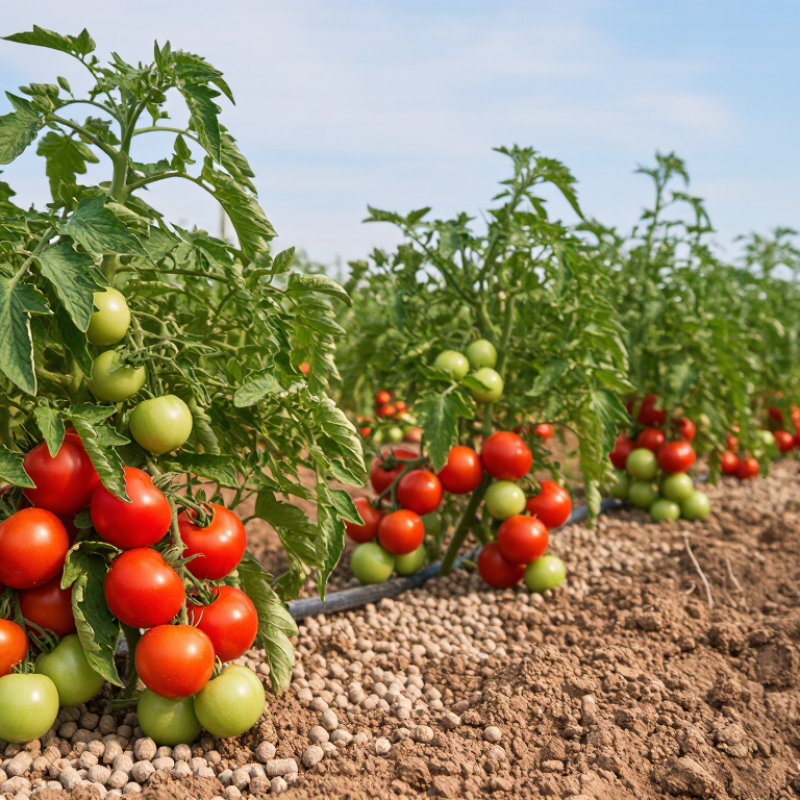
Understanding Granular Tomato Fertilizer and Its Role in Plant Growth
Granular tomato fertilizer supplies nutrients gradually around the root zone. Its main nutrients are nitrogen, phosphorus, and potassium, often shown as an N-P-K ratio. Nitrogen supports leafy growth, while phosphorus helps roots and flowers develop. Potassium supports fruit quality, water movement, and plant strength. The right balance matters more than a high number.
I have seen vigorous plants produce many leaves but few tomatoes after receiving excessive nitrogen. That mistake is easy to make. A soil test can reveal existing nutrients and guide a safer choice. For ordinary garden soil, a moderate fertilizer with less nitrogen may prevent excessive foliage. Granules should be spread evenly, kept away from the stem, and watered into the soil.
Timing also affects plant growth. Mix a measured amount into the planting area before transplanting, following the product label. Apply another light feeding when flowering begins if the soil needs it. Avoid placing dry granules against tender roots. They can cause root injury when moisture is limited. I once applied fertilizer before heavy rain, and much of it likely moved beyond the active root zone. That experience changed my practice. Weather, soil texture, and container size all influence how quickly nutrients become available. Container tomatoes usually need closer monitoring because frequent watering can remove nutrients. Growth should be observed, not guessed.
How to Choose Granular Tomato Fertilizer for Higher Yields? - Understanding Granular Tomato Fertilizer and Its Role in Plant Growth
| Fertilizer Profile | Representative N-P2O5-K2O Analysis | Most Suitable Growth Stage | Primary Nutrient Role | Granule or Release Feature | Practical Use Guidance | Important Consideration |
|---|---|---|---|---|---|---|
| Balanced maintenance fertilizer | 10-10-10 | Before planting or during early vegetative growth | Provides a relatively even supply of nitrogen, phosphorus, and potassium for general growth. | Usually available as conventional, water-soluble granules. | Useful when a soil test shows that all three major nutrients are moderately low or balanced. | Avoid repeated applications if soil nitrogen or phosphorus is already sufficient. |
| Moderate-nitrogen, higher-potassium fertilizer | 5-10-10 | Transplanting through flowering and fruit development | Supports root development, flowering, fruit production, and water regulation without supplying excessive nitrogen. | Commonly used as a granular base or side-dress fertilizer. | A practical choice when plants need potassium but soil nitrogen is adequate. | Higher phosphorus is not automatically beneficial; soil-test phosphorus before routine use. |
| Low-nitrogen, high-potassium fertilizer | 3-4-8 | Flowering, fruit set, and heavy fruit loading | Helps maintain potassium availability while limiting additional leafy growth from nitrogen. | May be supplied as standard or partially controlled-release granules. | Consider when mature plants are vigorous but fruit production or fruit quality is the priority. | Potassium cannot correct blossom-end rot if irregular watering or calcium transport is the actual cause. |
| Controlled-release complete fertilizer | Formulation varies; commonly complete N-P-K | Container growing or long-season field production | Provides a gradual nutrient supply that can reduce the frequency of applications. | Coated granules release nutrients over a stated period influenced by temperature and moisture. | Apply according to the product label and growing-medium volume rather than using a generic rate. | Warm, wet conditions may accelerate nutrient release; excessive application can still cause salt injury. |
| Organic nutrient granules | Analysis varies; often lower and less immediately available | Soil preparation and ongoing soil-building programs | Supplies nutrients as organic materials decompose and may contribute organic matter. | Release depends on microbial activity, temperature, moisture, and the material used. | Incorporate into the root zone before planting and allow time for nutrient mineralization. | Nutrient availability is slower and less predictable than the guaranteed analysis alone may suggest. |
| Calcium- or magnesium-containing blend | N-P-K plus Ca and/or Mg; analysis varies | Only when a soil or tissue test identifies a deficiency | Calcium supports cell-wall formation; magnesium is central to chlorophyll and photosynthesis. | May contain soluble mineral granules or blended secondary nutrients. | Use to correct a confirmed nutrient shortage, not as a universal substitute for balanced fertilization. | Excess calcium or magnesium can interfere with the uptake of other nutrients. |
Assessing Soil Nutrients and Tomato Variety Requirements
Choosing granular tomato fertilizer should begin with the soil, not the package label. A laboratory soil test reveals nitrogen, phosphorus, potassium, pH, and organic matter levels. It is more reliable than judging pale leaves alone. In my garden, I once added extra fertilizer after seeing slow growth. The plants produced huge leaves but few tomatoes. That mistake taught me to test before feeding.
Match the fertilizer to the soil report and the tomato variety. Cherry tomatoes often grow quickly and may need steady nutrition during heavy fruiting. Large-fruited and indeterminate varieties usually feed for a longer season. Determinate plants have a shorter production period, so excessive nitrogen can delay fruit development. Choose a granular formula with moderate nitrogen when soil fertility is already adequate. Avoid adding phosphorus automatically. Too much can accumulate and interfere with nutrient balance.
Apply granules evenly around the root zone, keeping them away from the stem. Water deeply after application. A slow-release product can reduce feeding frequency, but it still requires careful measurement. Recheck plant growth after two or three weeks. Healthy leaves should look green, not unnaturally dark. If flowering remains poor, the problem may involve heat, light, watering, or pollination rather than fertilizer. I still find this part difficult. Fertilizer cannot repair unsuitable soil or a stressed root system.
Comparing Fertilizer Formulas, Nutrient Ratios, and Release Rates
Choosing granular tomato fertilizer starts with the formula, not the packaging. In my tomato beds, excessive nitrogen produced dark leaves but fewer blossoms. A balanced formula, such as 5-5-5, supports steady early growth. During fruiting, a slightly higher potassium ratio may support fruit development. More potassium is not automatically better. Soil testing remains essential. It shows existing phosphorus, pH, and possible nutrient imbalances. Reliable decisions should match the plant’s growth stage and actual soil conditions.
Release rate also changes how fertilizer performs. Fast-release granules dissolve after irrigation and can produce visible growth within days. However, heavy rain may move nutrients beyond the root zone. Controlled-release granules feed plants gradually for several weeks. Cool soil can delay that process. Check the stated release period and temperature guidance. Never place concentrated granules against the stem. I once applied them too close to young plants and noticed scorched leaf edges. It was a small mistake, but a useful reminder.
Tips: Apply granules around the drip line, not beside the stem. Water thoroughly after application. Split the recommended amount into smaller applications when growth is vigorous. Watch new leaves, flower numbers, and fruit size. If leaves become excessively dark, reduce nitrogen. Recheck the soil before adding more fertilizer.
Selecting Granule Size, Application Method, and Seasonal Timing
Choosing granular tomato fertilizer starts with granule size, not the brightest package claim. Small granules dissolve quickly after irrigation and suit sandy soil or container plants. Larger granules release more slowly, but uneven particles can feed one plant heavily. Medium, uniform granules are often easier to spread around a garden row.
Keep fertilizer away from stems. About 8–10 centimeters is safer for young plants. I prefer side-dressing in a shallow ring, then covering it lightly with soil. A soil test should guide the nutrient rate, especially nitrogen and potassium. Too much nitrogen can create tall, dark foliage with disappointing fruit.
I have made that mistake before.
Timing changes the result. Mix only a modest amount into prepared soil before transplanting, unless the soil already tests rich. Apply a light side-dressing when plants begin flowering, then reassess during early fruit development. Water deeply afterward, but avoid washing granules against the stem. In hot weather, apply during the cooler morning and never onto dry, wilted plants. Container tomatoes may need smaller, more frequent applications because watering removes nutrients quickly. Stop routine feeding as the season cools and fruit production slows.
This schedule is not perfect for every garden; rainfall, soil texture, and plant vigor can shift the timing. Watch the leaves and fruit, but trust measured soil information more than appearance alone.
Adjusting Fertilizer Use for Higher Yields and Healthier Plants
How to Choose Granular Tomato Fertilizer for Higher Yields?
Higher yields depend on adjustment, not simply adding more granules. The USDA National Agricultural Statistics Service reported average U.S. processing tomato yields near 39.5 tons per acre in 2023. That level requires balanced nutrition and careful irrigation. Start with a laboratory soil test. It should measure pH, nitrogen, phosphorus, potassium, calcium, and organic matter. A granular fertilizer with moderate nitrogen and higher potassium may support fruit filling. Excess nitrogen often creates dark leaves, weak stems, and delayed fruiting. I have seen vigorous plants produce disappointing harvests.
Apply nutrients in smaller portions. Mix the first application into the planting zone, then side-dress during flowering and early fruit development. The USDA Natural Resources Conservation Service Nutrient Management Standard 590 recommends matching applications with crop demand, soil supply, and realistic yield goals. For home gardens, avoid copying commercial rates without adjustment. One handful can be too much for a young plant. Keep granules away from the stem, water thoroughly, and check leaves weekly.
Watch the plant, not only the package. Pale lower leaves may suggest nitrogen shortage, but poor roots can look similar. Blossom-end rot is commonly linked with inconsistent calcium movement and irregular watering, not simply low soil calcium. This is where practice gets imperfect. Weather changes the plan. Re-test soil after major amendments, record application dates, and reduce fertilizer when growth becomes soft, excessive, or unusually dark. Healthy plants usually show steady growth, firm stems, and fruit development without constant correction.
How to Choose Granular Tomato Fertilizer for Higher Yields?
Typical nutrient uptake for producing 1,000 kg of marketable tomatoes
Tomatoes generally remove more potassium than phosphorus from the growing medium, while nitrogen supports leaf growth and fruit development. Select a granular fertilizer by comparing its N-P-K analysis with a soil test, use moderate nitrogen rates, and provide adequate potassium during flowering and fruit filling. The values shown are typical agronomic ranges; actual uptake varies with cultivar, soil fertility, yield target, irrigation, and climate.
Nutrient values are expressed as elemental nutrients and represent commonly reported tomato crop-uptake ranges per 1,000 kg of marketable fruit.