China Best Ginseng Extract Manufacturers for Global Buyers
Choosing among China’s best ginseng extract manufacturers requires more than comparing prices or polished websites. Global buyers need evidence of consistent quality, transparent sourcing, and dependable communication. Ginseng Extract can vary greatly by species, growing region, extraction method, and active compound content. These differences affect flavor, color, solubility, and final product performance.
A reliable manufacturer should explain where the roots are grown and how they are handled. Clear batch records can show harvesting dates, processing conditions, and storage practices. Independent laboratory testing should verify identity, purity, microbiological safety, heavy metals, pesticides, and relevant ginsenoside levels. Ask for current certificates, product specifications, and representative samples. Documentation matters.
So does the factory floor.
Practical experience often reveals details that brochures omit. Buyers should examine cleaning procedures, water quality controls, production capacity, packaging options, and complaint handling. A serious supplier can discuss moisture protection, shelf-life testing, and shipment conditions without making exaggerated promises. Certifications may support credibility, but they should be checked with the issuing organization and matched to the actual facility.
No supplier is perfect. Even experienced manufacturers may face seasonal variation, delayed testing, or communication gaps. That is worth acknowledging. A careful evaluation should include trial orders, sample comparisons, written quality agreements, and realistic delivery timelines. This article reviews important factors for identifying dependable Chinese Ginseng Extract manufacturers serving international buyers. It focuses on verifiable practices, technical capability, and long-term cooperation rather than unsupported rankings. Each buyer must confirm that products meet the destination market’s applicable requirements.
Panax Ginseng Extract: Species, Plant Parts, and Industry Market Data
China Best Ginseng Extract Manufacturers for Global Buyers
Panax Ginseng Extract: Species, Plant Parts, and Industry Market Data
Panax ginseng is commonly called Asian or Korean ginseng. It differs from American ginseng, Panax quinquefolius. Species selection matters because ginsenoside patterns can vary. Six-year-old roots often attract stronger commercial interest. However, age alone does not prove superior quality. Soil, cultivar, drying temperature, and storage also affect the final extract.
Manufacturers mainly use the main root, while rootlets and fine roots may enter production too. Leaves, stems, and berries contain different compounds. Each plant part needs separate specifications. Buyers should request the extraction solvent, extract ratio, marker compounds, and plant-part details. Reliable documents should include identity testing, microbial limits, heavy metals, pesticides, and batch traceability. I also check whether the powder disperses evenly in water. It seems basic. Yet, poor dispersion may indicate processing issues.
Public market studies describe ginseng extract as a growing, multi-billion-dollar category, but estimates vary widely. Some reports forecast annual growth of roughly 6% to 9% through the early 2030s. These figures are directional, not guaranteed. Demand continues across functional foods, supplements, beverages, and personal care. China remains an important cultivation and processing base. Still, production claims require factory audits, recent test reports, and sample-to-batch comparisons. A low price may show efficiency. It may also reflect weaker raw material control.
Quality Metrics: HPLC Ginsenoside Profiles, Extract Ratios, and Moisture
For global buyers, ginseng extract quality begins with measurable evidence, not attractive packaging. A qualified supplier should provide batch-specific HPLC results. These reports should identify key ginsenosides, including Rg1, Rb1, Re, and Rg3. The profile matters more than a single total percentage. A strong total can still hide an unbalanced composition.
Extract ratios, such as 10:1, describe raw material concentration. They do not automatically prove higher potency or better performance. Buyers should compare the original root specification, extraction solvent, and finished yield. I have seen ratios presented without enough processing detail. That gap deserves attention.
Moisture is another practical control point. Excess moisture can encourage clumping, reduce shelf stability, and complicate filling. Suppliers may use loss-on-drying or Karl Fischer testing, but the method should appear on the certificate. A clear limit, test date, and batch number improve traceability. The powder should also be checked for appearance, odor, and foreign particles.
Ask for independent laboratory verification when results seem unusually polished. Review chromatograms, not only summary tables. One imperfect batch does not define a supplier, but unexplained variation should pause purchasing. Experienced quality teams connect HPLC profiles, extract ratios, and moisture data before approving production. That process protects consistency across shipments.
Chinese Manufacturing Process: From Raw Roots to Standardized Extract Powder
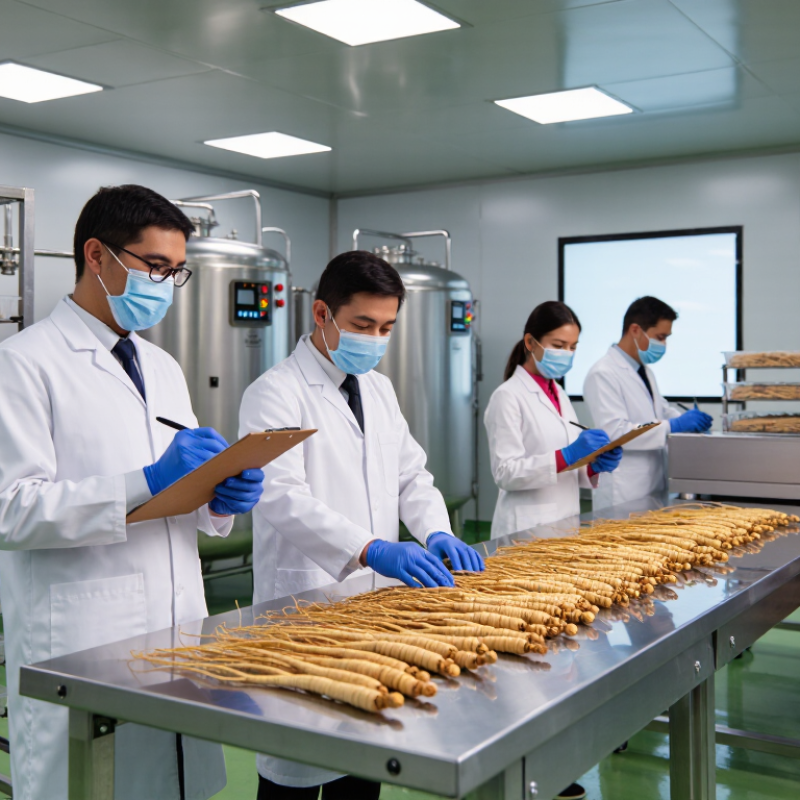
Reliable ginseng extract begins with carefully identified raw roots, not with a label on a finished pouch. Chinese manufacturers commonly inspect root age, appearance, moisture, and storage conditions before processing. Workers remove soil, damaged pieces, and foreign material by hand and through controlled washing. The roots are then sliced for more even drying. This practical step reduces variation during extraction.
Dried slices move into water or approved food-grade extraction systems, depending on the target specification. Temperature, extraction time, and liquid-to-root ratios require close control. Excessive heat may affect sensitive compounds. The extract is filtered, concentrated, and usually spray-dried into a fine powder. Carriers may improve flow and stability, but their presence should be clearly recorded. Particle size, moisture, and solubility are checked before packaging.
Standardization gives global buyers a measurable basis for comparison. Laboratories may test ginsenoside profiles, microbial limits, heavy metals, pesticides, and identity. Each batch should connect to supplier records, production logs, and test results. A retained sample also supports later investigation. No process is flawless. Root variation, seasonal conditions, and sampling errors can still influence results. Experienced manufacturers review these risks instead of hiding them. Buyers should request current specifications, certificates, and destination-market compliance documents before approval. Consistent powder is the goal, but honest documentation matters just as much.
China Best Ginseng Extract Manufacturers for Global Buyers - Chinese Manufacturing Process: From Raw Roots to Standardized Extract Powder
Reference manufacturing workflow and quality-control dimensions for Panax ginseng extract powder. Actual specifications may vary by formulation, extraction ratio, regulatory market, and customer requirements.
| Manufacturing Stage | Key Parameter | Typical Process or Specification | Quality-Control Focus | Output or Record | Status |
|---|---|---|---|---|---|
| 1. Botanical Identification | Plant material | Panax ginseng C.A. Meyer root, commonly supplied as cultivated Asian ginseng root. | Botanical identity, plant part, country or region of origin, harvest documentation, and supplier traceability. | Approved raw-material specification and traceability code. | Verified |
| 2. Raw Root Receiving | Incoming condition | Roots are inspected for foreign matter, visible mold, abnormal odor, insect damage, and excessive breakage. | Visual inspection, moisture testing, packaging integrity, and sampling according to a documented receiving procedure. | Incoming inspection report and retained sample. | Checked |
| 3. Cleaning and Sorting | Physical preparation | Soil and foreign materials are removed. Roots are sorted and washed using potable or suitably treated process water. | Foreign-matter control, water quality, sanitation records, and prevention of cross-contamination. | Cleaned and graded roots ready for drying or cutting. | Controlled |
| 4. Drying | Moisture reduction | Clean roots are dried under controlled conditions until they reach a stable moisture level suitable for storage and milling. | Drying temperature, time, final moisture, odor, color, and protection from excessive heat or rehydration. | Dried ginseng root with a recorded moisture result. | Recorded |
| 5. Cutting and Milling | Particle preparation | Dried roots are sliced or milled to increase surface area and improve contact with the extraction solvent. | Particle-size consistency, metal detection, equipment cleanliness, and batch identification. | Prepared root pieces or coarse powder. | Controlled |
| 6. Solvent Extraction | Extraction medium | Food-grade water, ethanol, or a water–ethanol mixture may be selected according to the target ginsenoside profile and intended use. | Solvent identity, solvent-to-material ratio, extraction time, temperature, and number of extraction cycles. | Filtered liquid extract containing soluble ginseng constituents. | Monitored |
| 7. Filtration and Concentration | Extract clarification | Solid residues are removed by filtration. The liquid extract is concentrated under controlled conditions, commonly using vacuum to limit thermal exposure. | Clarity, concentration solids, temperature, vacuum conditions, and prevention of excessive degradation. | Concentrated ginseng extract. | Monitored |
| 8. Standardization | Marker compounds | The concentrate may be adjusted or blended to meet a declared total ginsenoside specification, such as a buyer-defined percentage. | HPLC or validated chromatographic testing for ginsenosides; specification limits must be agreed before production. | Standardized liquid concentrate with a batch assay. | Assayed |
| 9. Spray Drying | Powder conversion | The standardized concentrate is atomized into a stream of hot air to produce a free-flowing extract powder. | Inlet and outlet temperatures, feed rate, carrier use if applicable, powder recovery, and thermal stability. | Dry ginseng extract powder. | Controlled |
| 10. Blending and Sieving | Uniformity | Powder is blended for homogeneity and passed through a defined sieve to remove agglomerates and achieve consistent handling properties. | Blend uniformity, particle-size distribution, bulk density, flowability, and foreign-particle control. | Uniform standardized extract powder. | Verified |
| 11. Finished-Product Testing | Identity and purity | Testing commonly includes appearance, odor, moisture, assay of declared ginsenosides, microbiological limits, and contaminant screening. | Microbial count, pathogens where applicable, heavy metals, pesticide residues, residual solvents, and applicable legal limits. | Certificate of analysis and release decision. | Released |
| 12. Packaging and Storage | Protection and shelf life | Powder is packed in clean, food-contact-compatible containers or lined bags and protected from moisture, heat, light, and strong odors. | Net weight, seal integrity, lot number, manufacture date, retest or expiry information, and storage conditions. | Finished packed goods with batch traceability. | Traceable |
| 13. Global Buyer Documentation | Export support | Documentation may include product specification, certificate of analysis, ingredient statement, allergen statement, safety data where required, and packing list. | Consistency between product labels, batch records, shipping documents, and destination-market requirements. | Export document package prepared for buyer review. | Documented |
| 14. Storage and Shipment | Logistics conditions | Store in a cool, dry, clean area in sealed packaging. Shipment conditions should minimize humidity, heat, physical damage, and contamination. | Warehouse temperature and humidity records, stock rotation, pallet condition, and transportation inspection. | Shipment released with traceable lot information. | Managed |
Supplier Verification: GMP, ISO 22000, HACCP, COA, and Batch Testing
China’s best ginseng extract manufacturers should prove quality through documented systems, not polished sales claims. GMP records should show controlled processing, sanitation, personnel training, and equipment maintenance. ISO 22000 demonstrates a structured food safety system, while HACCP identifies risks from raw material receipt to final packing. Ask for audit dates, certificate scopes, and issuing bodies. Certificates can expire.
Experienced buyers should also request a complete Certificate of Analysis for every production batch. The COA should identify the botanical name, plant part, extraction ratio, lot number, and test date. It should report active ginsenosides, moisture, microbial limits, heavy metals, pesticides, and solvent residues where relevant. Batch testing is stronger than a generic annual report. Confirm that the laboratory is qualified and that results match the shipped lot. A convincing document may still hide a missing method or unclear detection limit.
Tips: Request one recent COA, the related test report, and a sealed sample from the same lot. Compare labels, lot numbers, and production dates. Consider an independent laboratory check before a large order. It costs more, but uncertainty costs more later. Factory visits add useful evidence, although they cannot replace testing. Ask difficult questions politely. Suppliers with reliable systems usually answer with records, not vague promises. Your verification process may not be perfect, so record unanswered points and review them before approval.
Ginseng Extract Supplier Verification Checklist
The chart shows the number of practical evidence fields that global buyers should verify for each supplier qualification area. These checks cover certification scope, document validity, traceability, analytical results, and batch-specific testing. The figures are checklist counts, not company rankings or market-share data.
Global Buying Compliance: FDA, EU Rules, MOQ, Lead Times, and Pricing
Global buyers should treat ginseng extract as a regulated ingredient, not a simple commodity. The U.S. FDA does not pre-approve dietary supplements, but facilities must follow 21 CFR Part 111 cGMP requirements. Batch records, identity testing, microbial limits, heavy-metal results, and allergen controls should be available before shipment. A current certificate of analysis is essential. It is not enough by itself.
EU entry requires closer review. Ginseng ingredients may fall under food-supplement rules, health-claim controls, and, in some cases, Novel Food Regulation (EU) 2015/2283. Regulation (EU) 2023/915 also sets contaminant limits for food products. Buyers should verify the destination country, because enforcement can differ. WHO quality-control guidance for herbal medicines recommends botanical authentication and marker-compound testing. Practical checks include ginsenoside profiles, pesticide screening, solvent residues, and origin documents.
Commercial terms need equal attention. Industry market reports, including recent analyses from Grand View Research and Fortune Business Insights, describe continued growth in botanical extracts, but they do not guarantee stable prices. Standardized extracts usually cost more than basic powders. Typical supplier discussions may start around 25–100 kilograms, with lead times of 30–60 days after artwork and testing approval. Harvest timing can extend this window. Ask for three retained samples. Pricing should state extract ratio, ginsenoside percentage, packaging, testing, and Incoterms. Cheap quotes can hide weak documentation. That risk deserves reflection.