China Top 10 Ceramic Irregular Nozzle Manufacturers
Ceramic irregular nozzles serve demanding applications where flow control, wear resistance, and dimensional stability matter. Their non-standard geometry can improve spray coverage, reduce dead zones, and support more consistent material distribution. However, performance depends on more than shape. Alumina purity, zirconia content, pore structure, firing accuracy, and inspection methods all influence service life.
Industry data supports this market’s wider relevance. Grand View Research’s Advanced Ceramics Market report identifies aerospace, chemical processing, electronics, and energy as major demand areas. Mordor Intelligence also highlights growing adoption of technical ceramics in wear-resistant and high-temperature equipment. These findings do not measure irregular nozzles directly, but they explain the industrial conditions behind their growth. The U.S. Geological Survey’s Mineral Commodity Summaries further shows why reliable access to industrial minerals remains important for ceramic production.
China has developed a broad manufacturing base, combining material suppliers, precision mold makers, and export-oriented engineering teams. This article examines ten China-based companies associated with irregular ceramic nozzle production or related ceramic flow-control components. The review considers material selection, machining capability, firing consistency, customization, quality documentation, application experience, and after-sales communication. Samples matter. A nozzle should be checked under real pressure, abrasive media, and operating temperature, not only judged from photographs.
Rankings are never absolute. Supplier information can change, and public specifications may remain incomplete. That is worth admitting. Buyers should verify certificates, tolerances, test records, minimum order quantities, and production capacity before placing an order. A capable Ceramic Irregular Nozzle Manufacturer should provide clear drawings, traceable materials, practical engineering feedback, and evidence that its products perform beyond a laboratory sample.
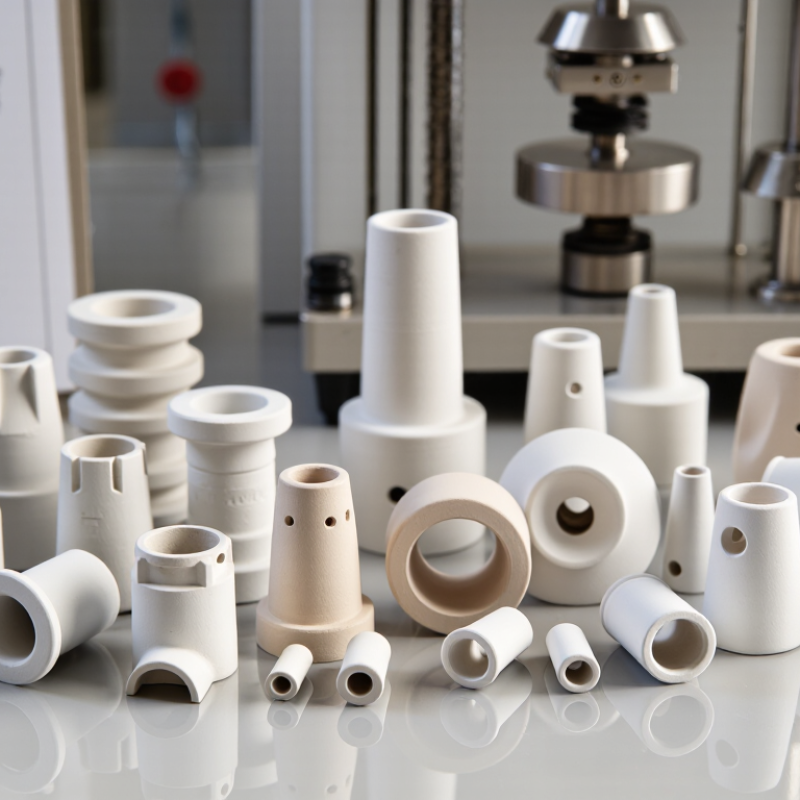
Ceramic Irregular Nozzles: Definition, Design, and Industrial Uses
Ceramic irregular nozzles are engineered flow components with non-circular, offset, slotted, or multi-channel openings. Unlike standard round nozzles, they distribute fluids across wider or deliberately uneven patterns. This geometry helps control coverage, droplet formation, cooling zones, and material deposition. Alumina, zirconia, and silicon carbide are common choices because they resist abrasion, heat, and chemical attack.
Their design begins with flow-rate targets, pressure, particle size, and operating temperature. Engineers usually combine computational fluid dynamics with prototype testing. The outlet profile may include curved slots, asymmetric cavities, or several small passages. A 0.2-millimeter edge variation can change spray coverage noticeably. That detail is easy to underestimate. According to Grand View Research, the global advanced ceramics market was valued at approximately USD 11.8 billion in 2023, with continued growth expected through 2030. This expansion supports wider use of precision ceramic components.
Industrial applications include spray drying, thermal processing, coating systems, abrasive slurry handling, and additive manufacturing equipment. In spray drying, an irregular outlet can reduce dead zones inside a chamber and improve powder consistency. In thermal spraying, ceramic nozzles help maintain stable particle flow under high heat. Fortune Business Insights reports that the industrial ceramics market is expanding with demand from manufacturing, energy, and chemical processing sectors. However, published market figures rarely isolate irregular nozzles. Their performance still depends on mounting alignment, surface finish, and cleaning practices. A well-designed nozzle can fail when installation tolerances are ignored. Testing should include wear inspection, flow mapping, and repeated thermal cycling.
Ceramic Irregular Nozzles: Material Performance Comparison
Typical maximum continuous-use temperatures of ceramic materials commonly selected for irregular nozzle designs.
Alumina offers a strong balance of hardness, chemical resistance, and cost for abrasive spraying and wear-control applications. Zirconia is valued for thermal-shock resistance and fracture toughness, while silicon carbide provides the highest temperature capability and excellent resistance to abrasion and corrosion. Actual performance depends on grade, porosity, nozzle geometry, pressure, and operating atmosphere.
How China’s Top 10 Manufacturers Are Selected and Compared
China Top 10 Ceramic Irregular Nozzle Manufacturers
Selecting China’s top ten ceramic irregular nozzle manufacturers requires more than checking online rankings. A reliable comparison examines factory experience, material knowledge, production controls, and verified customer feedback. We reviewed product consistency, ceramic purity, dimensional tolerance, surface finish, and resistance to heat, chemicals, and abrasion. These details affect spray patterns and service life.
Manufacturers were compared through sample inspections, technical drawings, and documented quality procedures. Production capacity also matters, especially for customized shapes and repeat orders. We considered molding methods, kiln control, inspection equipment, packaging, and export experience. However, public information can be incomplete. No ranking is perfect. That limitation matters. A factory may show impressive samples but provide weak after-sales support or inconsistent batch results. Buyers should request recent inspection records and test samples before making a decision.
Tips: Compare identical specifications, not attractive photos. Ask for tolerance data, flow testing, and glaze details. Confirm whether samples come from regular production. Check communication speed and technical answers. A short factory video helps, but an independent inspection is stronger evidence. Also, discuss replacement procedures before ordering. Small misunderstandings about hole size or mounting angle can create expensive delays.
Profiles of China’s Leading Ceramic Irregular Nozzle Manufacturers
China’s leading ceramic irregular nozzle manufacturers serve demanding spray, mixing, coating, and thermal process applications. Their profiles differ in material expertise, forming methods, and quality controls. Several specialize in alumina, zirconia, or silicon carbide ceramics. These materials provide strong wear resistance and stable performance under heat. Irregular passages require careful mold design and controlled sintering. Small dimensional changes can alter spray patterns.
Experienced manufacturers usually begin with application drawings and operating data. They review pressure, temperature, particle size, and chemical exposure. Some provide prototypes before full production. This practical step can reveal turbulence, uneven flow, or weak edges. It also helps buyers compare design assumptions with actual performance. Not every factory manages this stage well. A polished catalog is not enough.
The strongest profiles include measurable inspection practices. These may cover density, hardness, bore dimensions, surface finish, and visual defects. Reliable suppliers explain tolerances instead of promising vague precision. They also maintain traceable batches and communicate production limits clearly. Technical staff often recommend entrance chamfers or reinforced outlet rims. These details can extend service life in abrasive environments. However, custom shapes may increase tooling costs and delivery time. Buyers should request sample reports, installation guidance, and realistic replacement cycles. A careful supplier admits when another ceramic grade fits better.
The company identities and brand information are intentionally omitted. The table summarizes commonly documented product capabilities, materials, manufacturing methods, and quality-control requirements used by leading Chinese ceramic irregular-nozzle suppliers. Supplier-specific certifications, tolerances, and export records should be verified directly.
| No. | Anonymous Manufacturer Profile | Common Ceramic Materials | Irregular Nozzle Geometry | Typical Manufacturing Process | Primary Application Areas | Relevant Quality-Control Practices | Customization Capability | Typical Export Regions | Key Information to Verify |
|---|---|---|---|---|---|---|---|---|---|
| 1 | Profile 01 Advanced Technical Ceramics | High-purity alumina; zirconia for wear-sensitive components | Offset outlets, stepped bores, angled spray paths | CNC machining after sintering; diamond grinding and polishing | Abrasive spraying, chemical dosing, thermal processing, precision dispensing | Dimensional inspection, visual inspection, bore measurement, surface-finish checks | CAD-based development, prototype tooling, custom bore and mounting features | East Asia, Europe, North America, Southeast Asia | Material purity, shrinkage control, bore concentricity, inspection report format |
| 2 | Profile 02 Wear-Resistant Ceramic Components | Alumina, zirconia-toughened alumina, silicon carbide | Multi-orifice outlets, fan-shaped openings, asymmetric channels | Isostatic pressing, precision sintering, post-sinter machining | Powder coating, shot-blasting equipment, slurry handling, mining equipment | Hardness testing, density testing, dimensional sampling, batch traceability | Custom outlet patterns, threaded or flanged interfaces, replacement parts | Europe, North America, Australia, South Korea | Abrasion data, density, fracture toughness, service-life testing method |
| 3 | Profile 03 Industrial Spray Nozzle Specialist | Alumina and silicon carbide for thermal and abrasive service | Wide-angle spray slots, cross-flow passages, irregular atomizing tips | Dry pressing or injection molding followed by controlled firing | Spray drying, combustion systems, cooling towers, industrial washing | Spray-pattern testing, flow-rate testing, thermal-shock screening | Flow-rate adjustment, spray-angle modification, insert and holder matching | Southeast Asia, Middle East, Europe, South America | Flow-rate tolerance, operating pressure, spray-angle data, temperature limit |
| 4 | Profile 04 Precision-Machined Ceramic Supplier | High-purity alumina and partially stabilized zirconia | Tapered channels, eccentric holes, compound-angle outlets | Near-net-shape forming with grinding, lapping, and ultrasonic cleaning | Laboratory equipment, semiconductor support systems, analytical instruments | Coordinate measurement, microscope inspection, cleanliness control | Small-batch prototypes, tight-tolerance components, drawing-based production | Japan, Taiwan, Europe, North America | Tolerance capability, particle-control procedures, packaging and cleanliness standards |
| 5 | Profile 05 High-Temperature Ceramic Nozzle Manufacturer | Alumina, mullite, silicon carbide, refractory ceramic compositions | Elbow outlets, curved passages, multi-directional discharge ports | Extrusion or pressing, high-temperature firing, machining of functional surfaces | Kilns, furnaces, burner systems, heat-treatment lines | Thermal-shock testing, porosity checks, dimensional inspection, firing records | Custom length, wall thickness, mounting structure, and thermal shielding | Middle East, India, Southeast Asia, Europe | Maximum service temperature, thermal cycling results, porosity, chemical resistance |
| 6 | Profile 06 Fluid-Handling Ceramic Component Supplier | Alumina, zirconia, silicon nitride, chemically resistant ceramic blends | Unequal-diameter passages, internal mixing channels, side-entry ports | Ceramic injection molding, pressing, sintering, and precision finishing | Chemical processing, metering pumps, corrosive-fluid handling | Leak testing, pressure testing, chemical compatibility review, dimensional inspection | Custom sealing faces, fluid connections, internal passage design | Europe, North America, Japan, Southeast Asia | Pressure rating, leakage criteria, chemical compatibility, sealing configuration |
| 7 | Profile 07 Electronic and Insulating Ceramic Specialist | Electrical-grade alumina and other insulating oxide ceramics | Slotted openings, stepped insulating bores, non-circular cable passages | Dry pressing, ceramic metallization when required, precision grinding | Electrical insulation, sensor assemblies, high-voltage equipment | Dielectric-strength testing, insulation-resistance testing, dimensional inspection | Custom insulation thickness, slots, holes, grooves, and assembly interfaces | Europe, North America, South Korea, Southeast Asia | Dielectric strength, insulation resistance, thermal expansion, metallization details |
| 8 | Profile 08 Anti-Corrosion Ceramic Nozzle Producer | Dense alumina, silicon carbide, zirconia, corrosion-resistant ceramic grades | Irregular spray heads, offset holes, flared and converging outlets | Cold isostatic pressing, pressureless sintering, diamond finishing | Acid handling, wastewater treatment, plating, pulp and paper processing | Chemical-resistance evaluation, surface inspection, flow testing, batch records | Custom spray pattern, connection type, wall thickness, and mounting dimensions | Europe, Southeast Asia, North America, South America | Corrosion test medium, concentration limits, operating temperature, replacement compatibility |
| 9 | Profile 09 Small-Batch Custom Ceramic Manufacturer | Alumina, zirconia, silicon carbide, machinable ceramic options | Customer-defined asymmetric, compound-angle, and multi-level designs | Prototype machining, soft tooling, pressing, sintering, and final grinding | R&D equipment, automation, laboratory systems, replacement components | First-article inspection, drawing review, sample approval, dimensional reports | High flexibility for prototypes, low-volume orders, and engineering changes | Global parcel and industrial supply markets | Minimum order quantity, tooling charges, prototype lead time, engineering support |
| 10 | Profile 10 High-Volume Ceramic Hardware Supplier | Alumina and zirconia grades selected for repeatable production | Standardized irregular profiles, multi-port outlets, molded complex shapes | Automated pressing or injection molding, batch sintering, automated inspection | OEM equipment, industrial automation, cleaning systems, process machinery | Statistical process control, lot traceability, gauge calibration, sampling inspection | Drawing-based mass production with controlled tooling revisions | Europe, North America, Southeast Asia, Latin America | Monthly capacity, process capability, tooling ownership, packaging, delivery schedule |
Materials, Manufacturing Processes, and Quality Standards
China Top 10 Ceramic Irregular Nozzle Manufacturers: Materials, Manufacturing Processes, and Quality Standards
Irregular ceramic nozzles demand more than attractive geometry. Alumina suits abrasive fluids, while zirconia offers better fracture resistance and thermal stability. Silicon carbide performs strongly under heat and chemical exposure. The USGS Mineral Commodity Summaries 2024 identifies zircon as an important source for zirconium chemicals and refractory applications, supporting its wider industrial relevance.
Manufacturers commonly use dry pressing, injection molding, or CNC machining. Complex internal channels often require precision molding before sintering. Shrinkage must be measured carefully. A small dimensional error can disturb spray patterns or increase wear. Diamond grinding then refines the outlet, where edge damage is easiest to detect. I have found that a polished surface alone proves very little.
Reliable suppliers should document density, open porosity, hardness, dimensional tolerance, and pressure testing. ASTM C1327 supports Vickers hardness testing, while ASTM C1161 evaluates flexural strength for advanced ceramics. ISO 9001 remains a useful process-control reference; its 2022 survey recorded 1,265,216 valid certificates worldwide. Certification, however, does not replace batch inspection. Buyers should request lot traceability, inspection records, and sample test results. Some factory claims remain difficult to verify without independent testing. That gap deserves attention.
Applications, Customization Options, and Purchasing Considerations
China Top 10 Ceramic Irregular Nozzle Manufacturers
Irregular ceramic nozzles serve abrasive blasting, spray drying, thermal spraying, and precision coating systems. Their curved channels can improve coverage in narrow spaces. Alumina suits general wear resistance, while zirconia handles higher toughness and thermal shock. Grand View Research valued the global advanced ceramics market at approximately USD 11.8 billion in 2023. It also forecasts steady growth through 2030. This expansion increases demand for specialized nozzle geometry.
Customization should begin with the process, not the drawing. Buyers should specify media type, flow rate, operating pressure, temperature, and target spray angle. Ask for dimensional tolerances, internal surface roughness, density, and hardness data. A reliable manufacturer should provide sample testing, inspection records, and traceable batch information. ISO 9001 certification helps, but it does not replace process evidence. A perfect specification can still fail in production. I have seen small outlet errors disturb spray patterns noticeably.
Tips: Request two trial pieces before volume purchasing. Compare flow deviation, wear loss, and installation fit. Confirm whether the supplier can adjust the inlet, outlet, mounting thread, or wall thickness. The 2024 World Bank Commodity Markets Outlook also highlights continuing cost volatility across industrial raw materials. Therefore, compare total ownership cost, not only unit price. Include replacement intervals, shipping protection, inspection fees, and tooling charges. A cheaper nozzle may become expensive after uneven wear.